
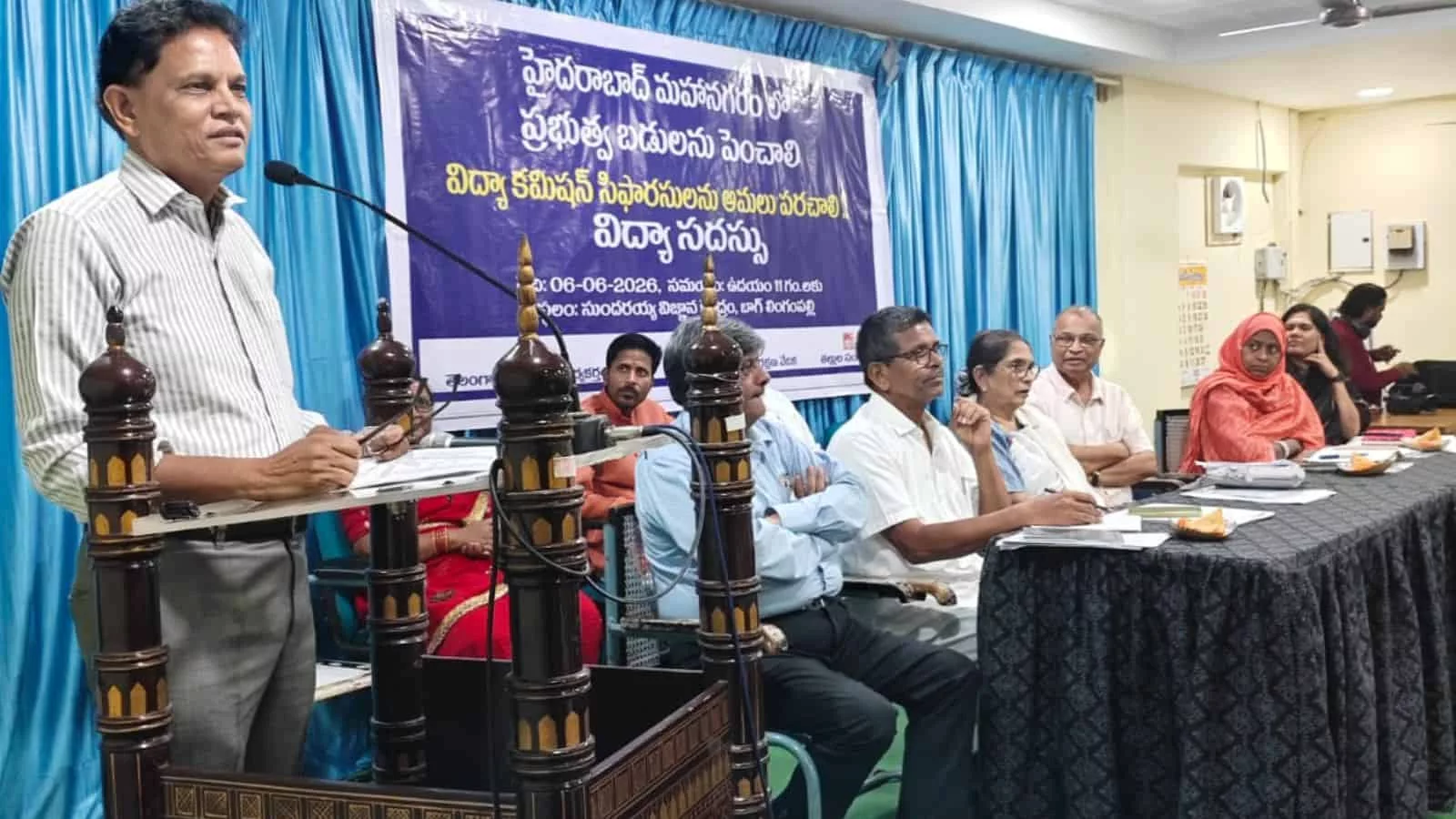
Hyderabad: Hyderabad’s children are falling through the cracks of its public school system, and the people who work in its slums every day have the numbers to prove it.
At a meeting held at Sundaraiah Vignana Kendram (SVK) in Baghlingampally on Saturday, June 6, social activists and grassroots workers from across 34 municipal divisions in Hyderabad came together with ward-level data, field surveys and personal testimony. They all point to the same conclusion – the city’s government school infrastructure has failed to keep pace with its population and children, especially in its poorest neighbourhoods, are paying the price.
On average, only around 13 per cent of children living in these divisions attend government schools. The rest are either enrolled in private schools, which charge anywhere between Rs 20,000 and Rs 50,000 or more a year, or are out of school entirely.
‘We can’t see our children become peddlers’
Among the most striking testimonies of the day was that of Jayalakshmi, a resident of Addagutta, the largest slum in Asia located in Quthbullapur Assembly constituency. She spent over 13 years as an ASHA worker before joining an NGO working on children’s education in the area.
Her division has 12 bastis with a combined population of 50,000. It has two government primary schools and one high school, together enrolling 911 children. Eight private schools in the same division absorb much of the rest, at a steep cost to families who can barely afford it.
“When someone in the family falls sick and the money runs dry, families are breaking apart,” she said.
With no adequate schools nearby and no structured environment to go to, some children in Addagutta are being lured into drug peddling, Jayalakshmi alleged. “We can’t see our own children as peddlers. We want them to become educated people,” she said.
Versions of Jayalakshmi’s account were echoed by volunteers from nearly every part of the city, but with their own local texture.
Also ReadTelangana caste survey: Where you are born still determines how far you study
Schools that flood, share buildings, run in shifts
Pavani, a volunteer from the Gowlipura division in Bandlaguda mandal, said one of only two government high schools in her area is built beside a drain. During the monsoons, water enters the classrooms and the approach road floods, making it difficult for children to even get home.
In Moula Ali, volunteer Durgesh pointed to a government high school established in 1960 – one that he himself attended until 1980 – where Telugu and Urdu medium schools are crammed into the same building, sharing space and a shortage of teachers.
From IS Sadan, Raghupathi Naik described a situation where children in government primary schools attend in two shifts, morning and afternoon. “The ones who come in the morning are roaming the streets by evening, and vice versa,” he said.
Many volunteers also noted that several schools operate out of private rented buildings, where a landlord’s change of heart or a better offer can displace a school overnight.
Speakers at the meeting held in SVK, Baghlingampally on Saturday, speaking on the various issues concerning government schools in Hyderabad, with the demand to establish a Telangana Public School in every municipal division. pic.twitter.com/pNkqZu2EGI— The Siasat Daily (@TheSiasatDaily) June 6, 2026
The city that outgrew its schools
The deeper story is one of a city that has grown far faster than its public infrastructure.
Former Teachers’ constituency MLC A Narsi Reddy put figures to the problem. There are 8.06 lakh children between the ages of six and 14 in the Hyderabad revenue district. A survey his organisation conducted last August across 500 government primary schools in nine mandals found that 122 schools had fewer than 30 children enrolled. Fewer than 100 schools were running properly. Sixty-five, he said, were in worse condition than cattle sheds.
He also noted that of Telangana’s 33 districts, only four – Hyderabad, Rangareddy, Malkajgiri and parts of Sangareddy, including Ameenpur, RC Puram and Patancheru – are seeing an increase in their child population, driven entirely by rural-to-urban migration. The pressure on urban schools, in other words, is only going to grow.
Dr Mazher Hussain, executive director of COVA Peace Network, said that in 1951, Hyderabad had 400 schools for a population of 16 lakh. Today, it has around 1,400 schools for a population of 1.16 crore. By his calculation, the city needs 30,000 schools.
He also recalled a survey his organisation conducted in the Old City decades ago, where five or six government primary schools were found housed in the same building. The pattern continues today. When a landlord asks a school to vacate, or a building deteriorates beyond use, the school gets absorbed into another one and the cycle of overcrowding deepens.
Also ReadTelangana caste census: SCs, STs three times more backward than general castes
The Arutla model and the demand to replicate it
The meeting’s central demand was to establish a Telangana Public School in every municipal division in Hyderabad, modelled on the school in Arutla that the state government has overhauled as a pilot project, and which participants described as now outperforming corporate schools.
Policy expert Kanneganti Ravi, however, noted the political complications. Even before the Telangana Education Commission had submitted its full report, the state government announced it would establish a Young India Integrated School in every Assembly constituency, earmarking Rs 30,000 crore in the state budget. “It seemed like they were trying to engage a few people,” he said.
Former Telangana Education Commission Chairman Akunuri Murali said the state government implement the commission’s recommendation that 18 per cent of the state budget be allocated to public education. Telangana currently allocates just 8 per cent, well below the national average of 15 per cent across states. “It is not some extravagant wish. All states combined average 15 per cent. Our 8 per cent is very low,” he said.
Murali noted the commission’s report was the product of 4,500 hours of work, including visits to and study of education systems in 18 to 20 countries. “Certain privileged sections of society who form a small minority would never like to see education accessed by all,” he alleged.
Chief Minister A Revanth Reddy had previously stated that lands recovered by the Hyderabad Disaster Response and Asset Protection Agency (HYDRAA) would be prioritised for school construction. Narsi Reddy noted that not a single school has received any such land allotment so far.
Government schools get corporate standards at Arutla. The morning sun usually rose over Arutla village to the sound of churning tractors and the quiet rustle of paddy fields. But today, the dawn air carried something different: the rhythmic, synchronized thrum of a school… pic.twitter.com/WSBgTYFbZZ— Jacob Ross (@JacobBhoompag) May 26, 2026
What the children are eating and not eating
Several speakers turned to another concern. The quality of mid-day meals, which are currently outsourced to the Akshaya Patra Foundation, an organisation associated with the Hare Krishna Movement (ISKCON).
Social activist Dr Lubna Sarwath questioned the nutritional value of food prepared in a centralised kitchen at 1 or 2 am and then transported to schools across the state in vans to be served at lunch. She pointed out that the relevant Act requires food to be prepared and served at the school itself and asked why children were not being given eggs, meat, millets, dry fruits or fruit.
Narsi Reddy cited a survey his organisation conducted two years ago across 29 government schools, which found that roughly half the rice served through Akshaya Patra was being left uneaten because of bad smell, poor taste and the monotony of an unchanging menu. At one school in Film Nagar with 1,000 students, he said, rice was being prepared for only 500 and even that was going to waste.
Kanneganti Ravi added that the state government had not fulfilled its election manifesto commitment to raise the wages of the 50,000 mid-day meal workers it employs across Telangana, while simultaneously routing the feeding of lakhs of children through Akshaya Patra at public expense.
Both Narsi Reddy and Dr Sarwath called for the contract with Akshaya Patra to be ended, for proper kitchens to be built within government schools and for nutritious, freshly prepared food to be served to children.
Get the latest updates in Hyderabad City News, Technology, Entertainment, Sports, Politics and Top Stories on WhatsApp & Telegram by subscribing to our channels. You can also download our app for Android and iOS.
