
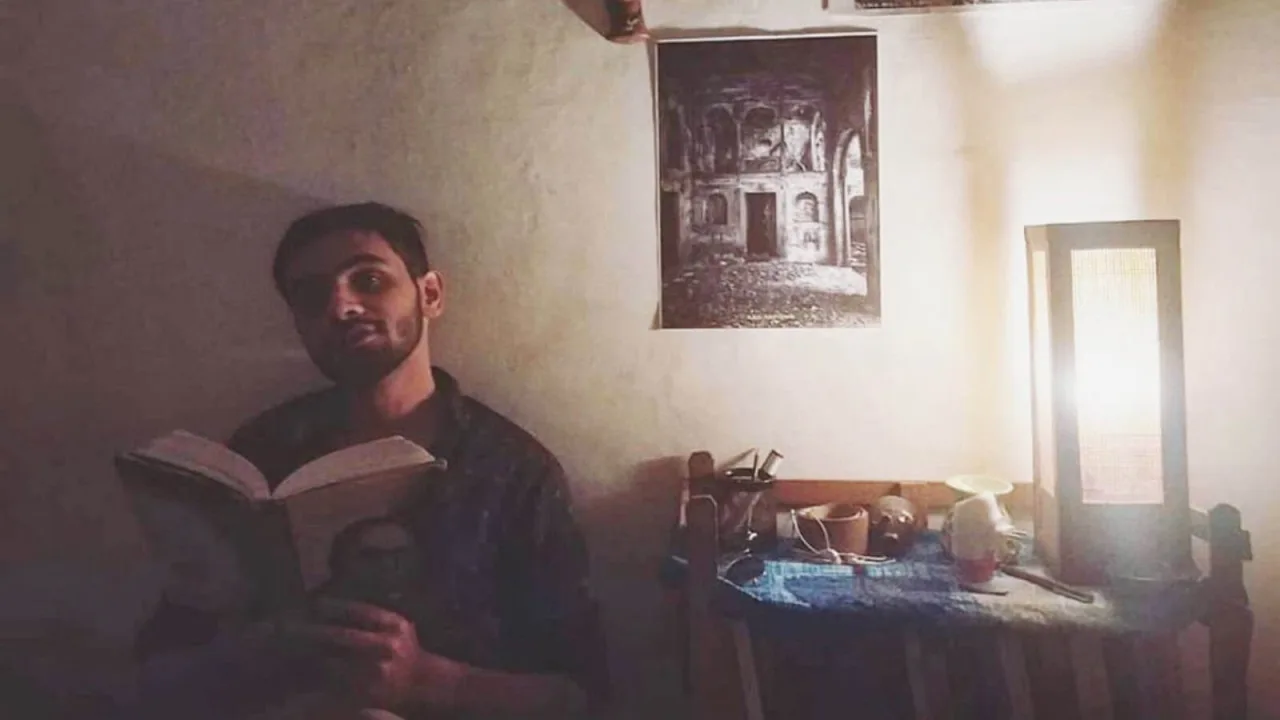
New Delhi: “How is it that I have spent most of my thirties in captivity? I wonder if this continuing injustice makes a difference to anyone? Does it move even a feather in our hallowed chambers of justice?” wrote Umar Khalid while describing a day in his life in Tihar Jail, Delhi, in a letter to his friends and family.
The excerpt, published by The Quint on September 7, details Umar’s ordinary day inside the prison, starting with the morning ginti or count of prisoners, at 6 am sharp. He describes “grumpily” waving his hand to show he is still alive so he can go back to sleep and soon falls into a dreamlike state. From the morning prayers echoing behind him, he hears, “Itni shakti humein dena data, mann ka vishwas kamzor ho na” (O Lord, give us so much strength that our faith does not weaken), and with it, prison activities begin.
Umar shares how he slowly acclimated to lizards, saying before his arrest he could not be in the same room as them. “But over time, I had to learn to co-exist with them as well as the other slimy creatures that live in my cell.” They are company, after all, he says.
An avid student activist during his time at the Jawaharlal Nehru University, Umar was arrested following the 2020 Delhi riots amid the anti-CAA and NRC protests. Masses of students across India took to the streets protesting against the Citizenship Amendment Act and National Registration of Citizens, stating it was an exclusionary law against muslims. Umar and fellow activist Sharjeel Imam were accused of being the “masterminds” behind the riots. However, Delhi Police have failed to produce a chargesheet against them, while their bail plea is repeatedly denied. The Supreme Court, on January 5, 2026, held that there is a prima facie case against the two under the draconian Unlawful Activities (Prevention) Act (UAPA), and it does not justify their enlargement on bail.
His days are marked by Shyam Lal and Shilpa, two prison cats who, he says, have become his two best friends in the six years. By 8 am, the inmates, enlisted for mushaqqat or paid prison labour, clock in at the jail factory.
“Most of the work inside jail is done by prisoners, and it is they who mainly keep the jail running. A small world in itself, a city within a city whose boundaries you cannot cross as per your own wishes,” Umar wrote, describing the work in Tihar Jail.
As newspapers are delivered to the inmates, he says reading about the NEET paper leak protests left him with a sense of hope. “I feel a restlessness rise within me. How wonderful would it be if there were a way to somehow get the sensory taste of the potential of dissent, and be surrounded by the charismatic youth of my country. These reports also lift me out of despair.”
He says he often worried about the “entire generation being destroyed by the slow drop of poison that this regime has been injecting into our country’s collective consciousness.” However, the youth of this country have shown us that there is hope, Umar said, adding that the regime “necessitated” an entire generation to stand up to injustice.
He claims that the Bharatiya Janata Party’s 12 years in power have demonstrated to the youth that the party and its ideological organisation, Rashtriya Swayamsevak Sangh (RSS), are “not working for nation-building but are destroying it brick by brick”.
At 12 pm, the inmates are locked back in their cells, and another ginti takes place. After lunch, he sits down to make notes for his next call with friends or family, as he is allotted only three 5-minute phone calls in a week. Before prison, he says, he never estimated the value of time, particularly that spent talking with loved ones. “It seems to me, in these five-minute calls, that in snatching time from you, time to simply speak, the state is putting limits on your freedom of expression. How long is five minutes!”
He says that he prepares before a call by choosing the precise words to convey his feelings and thoughts, stating that the “sheer lack of time” to speak to family can push a person into isolation.
At 3 pm, the inmates are locked out of their cells for tea, where Umar hears tales of other prisoners’ lives and how they ended up in jail. Around 4 pm, while on his evening walk, he witnesses various kinds of prisoners. One works out with Bisleri bottles filled with sand for better sleep; some seek divine help; another group holds their daily conference on life sentences, while others pluck mangoes from the trees or gather fallen jamun.
Again, the warder takes rounds and calls out prisoners’ names at 5 pm, and Umar says, just like that, another day comes to an end. “Within this monotony, one loses a sense of time. Days blur into each other,” he said, adding that he finds it difficult to comprehend that he has finished six years in prison.
Initially, he kept track of time through the books he read or by the court dates. However, after many years, he now marks his days by observing the change in seasons. “The cell in summer pushes you to your extremes. Both body and psyche seem to be caught in an existential state and, call it necessity or radical freedom, you come up with techniques to survive.
Most nights, Umar says, sleep takes over after what seems to be a very long time. To help, he reads with the radio in the background while memories swirl around in his head, making him melancholic. “I am strangely peaceful in these last hours of the day. I read till sleep takes over.” But often he is forced to wake from the extreme heat, resulting in breathlessness.
He describes it, saying, “The thing about breathlessness is that it makes the otherwise involuntary breathing visible and shatters bodily transparency. The acute physical agony is completely invisible to anyone other than your body, and I might even go on to say that this overwhelming experience is total.”
In prison, Umar says, one has to take over the role of a medical expert, and over time he has come to understand the mechanism of his breath.
“To stabilise my breath, I must exert physical techniques and at the same time reckon with the violence that has changed my body so much. And not surprisingly, the physical sensation of breathing failure triggers panic, and I feel as if I am spiralling into a bad space. How is it that I have spent most of my thirties in captivity? I wonder if this continuing injustice makes a difference to anyone? Does it move even a feather in our hallowed chambers of justice?”
Unable to find his pills for anxiety, he tries to go back to sleep and just as he drifts back to sleep, the warder comes: “Khalid, utho…haath hilao.”
Stay updated with our WhatsApp & Telegram by subscribing to our channels. For all the latest CAA-NRC updates, download our app Android and iOS.


Comments (0)
No comments yet. Be the first to share your thoughts!
Leave a Comment
Your comment will appear after moderation. Your email will not be published.