
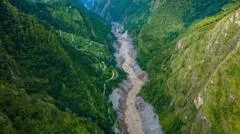
The death toll in Nepal from devastating floods on the border with Tibet has crossed 1,000
Nepal's devastating floods have exposed a risk that does not stop at its borders.
India and Nepal share the rivers that rise in the Himalayas, but the relationship between a flood in Nepal and a disaster in India is more complicated than a simple story of water flowing downstream, say experts.
Some floods can race out of the mountains carrying enormous quantities of mud, rock and debris. Others may lose much of their force as they reach the plains, leaving behind a more conventional flood.
And whether that water becomes a disaster in India depends not only on how much rain has fallen in Nepal, but also on rainfall, river levels, embankments, drainage and development on the Indian side.
Nepal's floods are a warning for India - not simply because water flows south across the border, but because the two countries share a vast and increasingly volatile Himalayan river system.
Nepal has more than 6,000 rivers and streams, most draining south into India and the Ganges
Nepal has more than 6,000 rivers and streams, most draining south into India and the Ganges.
Three major systems dominate: the Kosi in the east, the Gandaki (Gandak in India) in the centre and the Karnali (Ghaghara in India) in the west, with the Mahakali (Sharda) along the western border.
A dozen smaller rivers rising in the Siwaliks and Chure - including the Bagmati, Kamala, Rapti and Babai - are less famous but can produce faster, more unpredictable floods because their catchments are small and steep.
Seven to nine major rivers flow from Nepal into the Indian plains, and they are responsible for flooding in India, according to Manish Shrestha, a hydrologist at the International Centre for Integrated Mountain Development (ICIMOD).
India's Central Water Commission identifies the Kosi, Gandak, Bagmati and Ghaghara as some of the main transboundary rivers.
Bihar is India's worst flood-prone state
Bihar is by far the most exposed Indian state, with roughly three-quarters of north Bihar officially classified as flood-prone.
Almost all the major rivers that flood the state originate in Nepal, with the Kosi - the "sorrow of Bihar" - the most notorious, followed by the Gandak, Bagmati and Kamala.
Eastern Uttar Pradesh is vulnerable to the Ghaghara, Rapti and Gandak rivers. Districts like Gorakhpur, Bahraich, Lakhimpur Kheri and Shravasti are regularly affected.
Uttarakhand state shares the Mahakali-Sharda rivers. North Bengal receives the Mechi and Mahananda.
"Bihar dominates in scale. Uttar Pradesh is second and often under-reported," says Pradeep Man Dangol, hydrologist at ICIMOD.
Bihar bears the greatest burden, but Uttar Pradesh is a significant and often overlooked part of the risk.
A view of a flood-affected district in India's Bihar in 2008
Think of it as a three-part chain, say hydrologists.
First, the rain: where it falls and how heavily.
Flood peaks reaching India are often generated not in the high Himalayas but lower down, in the Siwaliks, Chure and Terai, where intense monsoon rain can fall on steep, small catchments.
Nepal's rivers cross a sharp break in slope at the mountain front, drop their sediment, and spread across the plains as braided, shifting channels.
How bad the flooding becomes depends on what the water encounters - the volume of rain on the Indian side, how full the Ganges is, embankments and barrages, and blocked drainage from roads, railways and settlements on the floodplain.
So the peak flow at the border is largely determined by rainfall in Nepal. The severity of flooding depends at least as much on conditions in India.
The 2008 Kosi disaster shows why: the river was carrying far less water than the embankment was designed to handle. The catastrophe was caused by the embankment failing, not by an exceptional flood.
"For the peak flow arriving at the border, largely Nepal's rainfall; for the severity of flooding once it arrives, at least as much on Indian conditions," says Saswata Sanyal, ICIMOD's intervention manager for disaster risk reduction.
The 2008 Kosi disaster is a powerful illustration.
Nearly 400 people died in Bihar after the Kosi breached an embankment in Nepal. But, remarkably, it was not an extraordinary high-flow event on the river.
According to Rajiv Sinha, a professor of earth sciences at Indian Institute of Technology (IIT), Kanpur, the flow was only about a tenth of the river's carrying capacity. The catastrophe was caused by a breach in an embankment built decades earlier and inadequately maintained.
"The embankments constructed in the 1950s and 1960s had not been properly maintained. They had become eroded and eventually developed a weak point. The river breached its embankment through these vulnerable points and entered parts of India that had not seen flooding for perhaps 100 years," says Sinha.
The failure, in other words, was "structural, not hydrological", adds Sanyal.
For ordinary monsoon floods, India may have "roughly 12 hours to two days of warning", according to Sanyal, depending on how quickly the water travels downstream.
Water can take about a day to reach the Bihar plains from the Nepal mountain front along the Kosi and Gandak, and somewhat longer along the Ghaghara.
Flash floods from the Chure rivers can arrive within hours.
A landslide-dam burst or debris flow can be even faster - in the current floods, the peak surge from Rasuwa reached Triveni, near the Indian border, in about seven-and-a-half hours.
India and Nepal do share real-time rainfall and river-level data from a network of stations. Nepal's Department of Hydrology and Meteorology feeds rainfall and river levels to India's Central Water Commission, which uses them for flood forecasts.
They include too few real-time monitoring stations in the fastest-flowing Chure catchments. There's also no single shared forecasting model between the two countries; and limited routine sharing on embankment conditions, river-channel changes and sediment.
And then there's, crucially, the last mile.



Comments (0)
No comments yet. Be the first to share your thoughts!
Leave a Comment
Your comment will appear after moderation. Your email will not be published.