
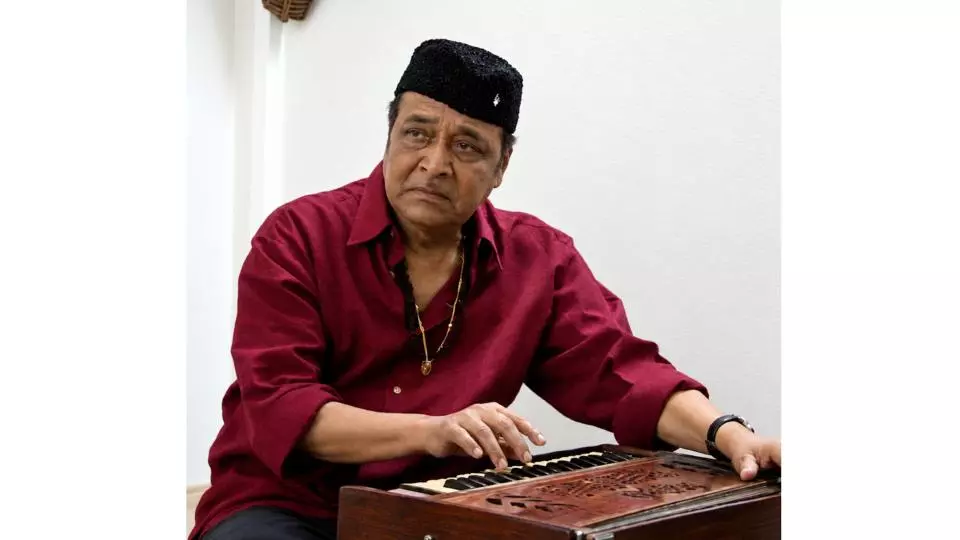
Music disappears the moment it is played, but the objects through which it is created can remain. As India marks the birth centenary of Dr. Bhupen Hazarika, the Indian Music Experience Museum (IME), Bengaluru, has added one of the legendary musician’s personal harmoniums to its permanent collection. The instrument was formally handed over to the museum by members of Hazarika’s family, including Manjula Hazarika, and the Bhupen Hazarika Cultural Trust on September 20, 2026.
For Preema John, Museum Director at IME, the significance of the harmonium lies precisely in its connection to the physical act of making music. “Recordings capture the finished acoustic output, and archives document biographical chronologies, but an artist’s personal instrument holds the tactile memory of the creative labour itself,” she says.
Hazarika was a composer, lyricist, singer, filmmaker, writer and public intellectual, and Preema sees the harmonium as more than an accompaniment to his work. “It was the vehicle through which he translated human struggle into sound,” she says.
The instrument, she points out, carries visible evidence of years of use. “When you examine it closely, you see the ergonomics of genius, the wear on the bellows and the patina on the keys that breathed life into monumental anthems like ‘Manuhe Manuhor Babe’ and ‘Bistirno Parore’.”
For Preema, those marks also point to something that recordings cannot fully convey: the solitary work that comes before a song reaches an audience. The harmonium, she says, “bears witness to how traditional folk rhythms were transformed into calls for equality across riverbanks, villages, and international stages.”
That is also what gives personal instruments a cultural significance beyond their material value. “A musical instrument used by a figure of Dr. Hazarika’s stature transcends its composition of wood, brass, and other materials. It becomes a secular relic,” Preema says.
She refers to an observation by artist M.F. Husain, who saw Hazarika as someone who “painted pictures with his music”, creating landscapes of empathy, struggle and human solidarity through sound. Because that sound disappears after it is performed, Preema says, the instrument becomes “a permanent anchor for collective memory.”
For communities across Assam, the Northeast and beyond, she believes the harmonium represents more than a musician’s working object. “It is a physical vessel of cultural dignity, social justice, and historical voice.”
The acquisition also comes at a time when much of the way music is encountered has become detached from the physical process of creating it. Streaming platforms have made music readily available, but, as Preema puts it, it is increasingly consumed as “frictionless, disembodied data files”, removed from the physical effort and context behind the recording.
A museum can restore some of that connection. “Encountering a physical instrument in a museum like IME creates a vital, grounding pause that re-anchors sound in material reality,” she says.
Preema recalls encountering Hazarika’s music herself through school assemblies in the 1990s, including compositions such as “Dola He Dola”. His songs were often used in schools because of their themes of human dignity, empathy and social equality. “He turned folk cadences into cultural pedagogy,” she says.
For younger visitors, standing in front of the actual instrument used by Hazarika changes the relationship between the listener and the artist. “The distance between the listener and the legend collapses,” Preema says. The object also helps demystify the creative process, showing that music that endures is rooted in “craft, discipline, and human hands.”
Personal artefacts can similarly change the way museums tell musical history. Preema believes institutional histories can sometimes reduce music to “dry, encyclopedic timelines or rigid classical lineages”. Objects used by artists introduce something more intimate into those accounts.
“Hazarika’s harmonium embodies a rare synthesis,” she says, pointing to an artist who combined a deep engagement with folk traditions and mass theatre with his academic and intellectual interests.
For IME, preserving the harmonium is therefore not about placing it behind glass and leaving it there. “The core responsibility for IME is ensuring that preservation does not result in alienation,” Preema says. “The goal is never to entomb an artifact behind glass, but to keep its voice audible and its context alive.”
That requires a balance between conservation and interpretation. The physical harmonium will be protected, while its story will continue to be told through oral histories, archival recordings, digital interactives and contextual storytelling.
“The visitor encounters a preserved national treasure, but walks away understanding the living human spirit that animated it,” Preema says.
The acquisition also adds another dimension to IME’s permanent collection. With Hazarika’s harmonium, the museum now holds memorabilia associated with five of the six musicians who have received the Bharat Ratna, including M.S. Subbulakshmi, Ustad Bismillah Khan, Pandit Ravi Shankar and Pandit Bhimsen Joshi.
For Preema, bringing these figures together allows the museum to tell a broader story about the country’s musical traditions.
“India’s musical identity is not singular or monolithic,” she says. It exists across the classical traditions of Hindustani and Carnatic music, as well as in “the humanist, grassroots balladeering of Dr. Bhupen Hazarika.”
His harmonium therefore does more than represent one musician. It expands the story of what constitutes India’s musical heritage, bringing regional traditions, folk influences and questions of social consciousness into the same institutional space.
“It reaffirms our commitment to building an institution where historic legacies remain dynamic, educational, and accessible to generations of scholars, young learners, and music lovers,” Preema says.


Comments (0)
No comments yet. Be the first to share your thoughts!
Leave a Comment
Your comment will appear after moderation. Your email will not be published.