
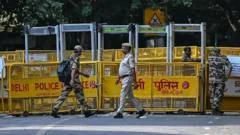
Police have been deployed in big numbers even during demonstrations by opposition parties in the lead up to Saturday's 'cockroach' protest
Parts of the Indian capital, Delhi, have been turned into a fortress, with tens of thousands of security forces deployed, as the influential Gen Z-led "cockroach" movement has called for a major protest on Saturday.
The protesters are seeking electoral reforms and the resignation of Chief Election Commissioner (CEC) Gyanesh Kumar over allegations of manipulating voters' lists.
The Election Commission has denied this and Kumar is yet to comment on calls for his resignation.
The protest comes just months after the movement brought thousands of young people onto Delhi's streets in July, in demonstrations that saw violent clashes with police and forced India's education minister to resign.
Police say they have denied permission for Saturday's gathering, and all roads leading to Jantar Mantar, the main protest venue, have been closed off with huge metal barricades.
The restrictions have caused major disruption across central Delhi, with traffic diverted from several key roads. A journey that would normally take 15 minutes took more than an hour this morning.
At Jantar Mantar, police and paramilitary personnel are stationed behind barricades and ropes, preventing people from entering the protest site. Drones could be seen flying overhead.
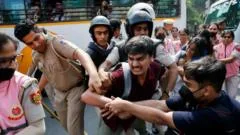
Some protesters who arrived early were stopped and questioned by security personnel. The BBC also saw at least five people being detained near the site.
Journalists covering the protest have been cordoned off into a designated area nearby.
At a nearby roundabout, loudspeakers repeatedly broadcast appeals for people to cooperate with the police.
Delhi Police has defended the measures, saying they were necessary to maintain public safety and prevent overcrowding at Jantar Mantar, which can accommodate only 1,000 people at a time.
Sabika Muzaffar has travelled from nearby Haryana state with her mother to take part in Saturday's protest
Several trains to Delhi have also been cancelled and police have ordered dozens of metro stations shut to prevent protesters from gathering.
But Abhijeet Dipke, founder of the Cockroach Janata Party (CJP) - the online satirical movement that is spearheading the protests - has said the CJP will march to Jantar Mantar on Saturday morning "come what may".
"If you want to jail us or even shoot us we are prepared," he added, addressing Prime Minister Narendra Modi in a post on X.
The CJP first emerged as a major protest movement during weeks of demonstrations demanding education reforms over the summer. The resignation of Education Minister Dharmendra Pradhan in July was seen as a major victory for the group.
CJP protesters returned to the streets last week with a rally in Mumbai to demand Kumar's resignation. On Thursday, they held another large rally in the southern city of Bengaluru (formerly Bangalore).
Student groups and opposition parties have also protested in the capital over the past few days.
The CJP held a rally in Bengaluru city on Thursday against CEC Kumar
Saturday's protests are being billed as the biggest in recent times as they are also being supported by several opposition parties, farmer organisations and student groups.
CJP leaders allege the authorities have been preventing many of their supporters from reaching Delhi.
In the capital, more than 30,000 police and paramilitary personnel have been deployed and authorities have appealed to citizens to stay away from protests.
Police official Nupur Prasad told a press conference, external that one of the reasons for denying permission to protest at Jantar Mantar was the "short notice" given by the CJP.
"Under current guidelines, an application to organise an event at Jantar Mantar must be submitted at least 10 days prior to the scheduled date," she said.
Also, she added that in the past, the CJP had not followed "lawful directions" given to them.
"In light of the non-compliance with prescribed procedures, the failure to adhere to past legal directions, and the current state of public safety, law and order, and traffic regulation, permission for the proposed protest at Jantar Mantar is hereby denied."
The CJP have questioned police denying them permission for the protest - they say that legally they only have to inform the police and do not need their approval to gather.
Gyanesh Kumar is at the centre of the voter-roll revision controversy
At the centre of the row is a controversial revision of the country's electoral rolls known as the Special Intensive Revision, or SIR, which began last year.
The Election Commission says it is to remove duplicate and ineligible entries - and so far, 130 million names have been struck off the voters' list.
But opposition parties and activists have alleged that many of those are eligible voters and that the process is being manipulated by CEC Kumar to favour Modi's Bharatiya Janata Party (BJP) during elections. Both the BJP and the Election Commission have rejected the accusations.
The past few days have also seen a major escalation in the opposition's standoff with the Election Commission.
For three days in a row starting Tuesday, Delhi witnessed dramatic scenes with police breaking up protests by opposition leader Rahul Gandhi and other MPs over the issue.
Videos showing police forcing Gandhi on to a bus and preventing him from climbing out of the bus window subsequently went viral on social media.


Comments (0)
No comments yet. Be the first to share your thoughts!
Leave a Comment
Your comment will appear after moderation. Your email will not be published.