
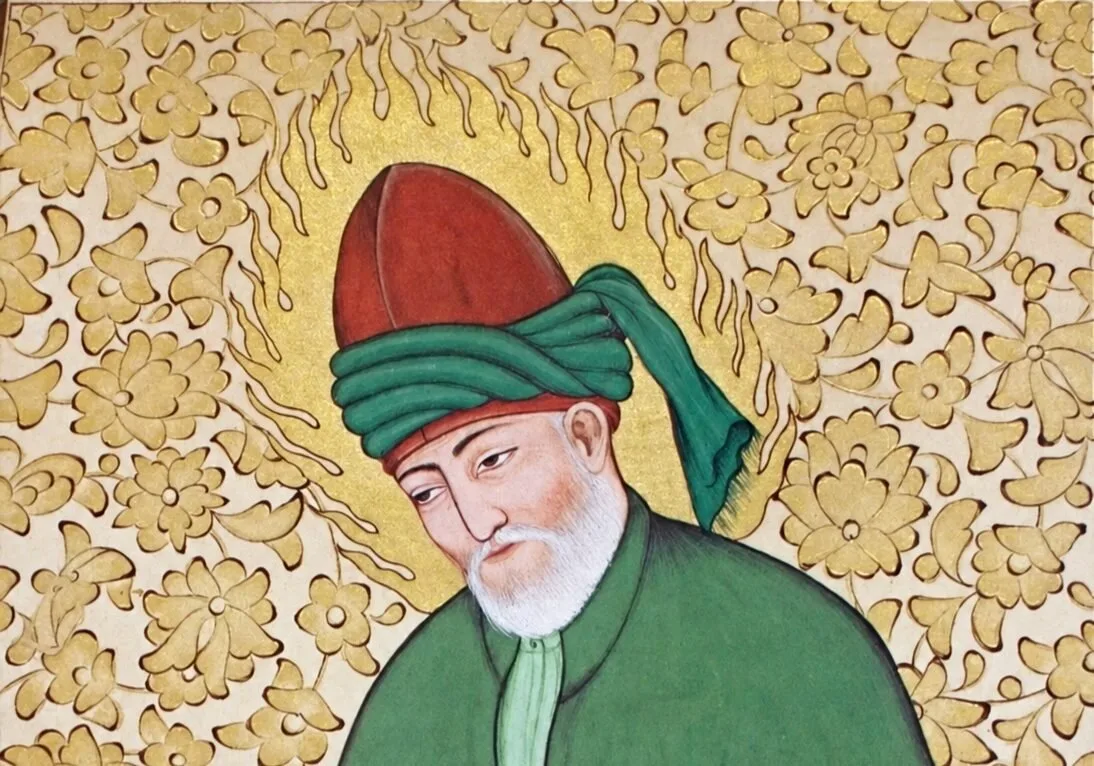
(RAHNUMA) In the rich tapestry of Persian literary and spiritual heritage, few figures shine as brightly or as intertwined as Shams-i Tabrizi and Jalal al-Din Muhammad Rumi (known as Molana or Mevlana). Their meeting in the mid-thirteenth century stands as one of the most consequential encounters in the history of world literature—a catalyst that transformed a distinguished Islamic scholar into one of the greatest mystical poets of all time. On the occasion of commemorating these towering figures of the Persian language, it is fitting to reflect on their individual and joint significance within Persian literature and the profound, lasting influence they have exerted across global cultures.
Shams and Rumi: The Transformative Meeting
Shams al-Din Muhammad of Tabriz (c. 1185–1248), a wandering dervish and mystic of unconventional temperament, remains an enigmatic yet pivotal presence.
The meeting was transformative. Traditional accounts describe an intense spiritual companionship lasting roughly two years (with interruptions), during which Shams challenged Rumi to move beyond bookish knowledge toward direct, experiential realization of the divine. When Shams disappeared (1247–1248), the resulting grief and longing ignited an extraordinary poetic outpouring.
Rumi dedicated his vast collection of lyric poetry, the Divan-e Shams-e Tabrizi (The Collected Works of Shams of Tabriz), to his companion. In these thousands of ghazals and quatrains, Rumi often signed Shams’s name rather than his own, treating Shams as both the earthly beloved and a manifestation of the divine sun (shams means “sun” in Arabic). Later, at the encouragement of his disciple Husam al-Din Chalabi, Rumi composed the Masnavi-ye Ma’navi (Spiritual Couplets), a monumental didactic epic of some 25,000 verses that explores the roots of spiritual truth through stories, parables, and mystical teaching. Without Shams, scholars widely agree, the Rumi the world knows—the ecstatic poet of love and union—would not have existed.
Their Place Among the Greats of Persian Literature
Within the Persian literary tradition, Rumi occupies a supreme position. Persian poetry had already produced giants such as Ferdowsi, Rudaki, Attar, and later Hafez and Saadi, but Rumi’s work elevated Sufi mysticism to new heights of emotional intensity, philosophical depth, and linguistic beauty. The Divan ranks among the greatest achievements of Persian lyric poetry, while the Masnavi has been revered for centuries as a spiritual encyclopedia—sometimes called “the Quran in the Persian tongue” for its profound moral and metaphysical insights.
Shams himself, though less a prolific writer (his recorded discourses survive in the Maqalat-e Shams), lives primarily through Rumi’s verse. He functions as both historical catalyst and symbolic archetype: the radical spiritual guide who awakens latent potential. Together, they embody core themes of classical Persian Sufi literature—divine love (ishq), longing for union, the annihilation of the ego (fana), and the ultimate unity of existence. Their legacy helped shape the Mevlevi order (the Whirling Dervishes), whose sema ceremony continues to express these ideas through music and movement. In Persian-speaking cultures and beyond the Islamic world, they remain symbols of the highest aspirations of the language: the capacity of poetry to convey the ineffable.
Influence on World Literature and Global Culture
The impact of Shams and Rumi extends far beyond the Persianate world. Rumi’s poetry began reaching European readers through Orientalist scholarship in the eighteenth and nineteenth centuries. Early translators such as William Jones, Reynold A. Nicholson, and A.J. Arberry introduced his work to academic audiences. In the late twentieth century, popular adaptations—most notably those by the American poet Coleman Barks—propelled Rumi to unprecedented popularity in the West. By the 1990s and 2000s, Rumi had become the best-selling poet in the United States, with his verses appearing on greeting cards, in music, self-help literature, and popular culture.
This global reception has not been without controversy. Popular Western versions often emphasize universal themes of love and spirituality while softening or omitting the specifically Islamic and Sufi contexts of the original Persian. Scholars have noted both the power of this cultural translation and the risks of decontextualization. Yet the underlying appeal remains genuine: Rumi’s poetry speaks across religious, linguistic, and cultural boundaries about the human longing for connection, the transformative power of love, and the search for meaning beyond the material.
UNESCO recognized Rumi’s stature by declaring 2007 the International Year of Rumi on the 800th anniversary of his birth. Annual commemorations continue, in September 29 for Shams and September 30 for Rumi, in Iranian cities associated with Shams, such as Tabriz and Khoy. Their story has inspired novels, films, academic studies, and interfaith dialogue worldwide. Writers from Goethe to modern poets have drawn on the broader Persian mystical tradition that Rumi and Shams exemplify, while their emphasis on love as a path to the divine resonates in comparative mysticism with traditions as diverse as Christian, Hindu, and Buddhist thought.
Shams of Tabriz and Jalal al-Din Rumi stand as enduring monuments of the Persian language’s capacity for spiritual and artistic expression. Shams provided the spark; Rumi transformed that spark into a lasting flame of poetry that continues to illuminate hearts across continents and centuries. Their relationship reminds us that literature at its highest is not merely aesthetic but transformative—capable of changing a single life and, through that change, touching the world.
As we commemorate these great figures, we celebrate not only historical genius but a living tradition: the invitation, still extended through their words, to look beyond outward forms toward the sun of the soul. In an age of division, their message of love, unity, and the shared human quest for the divine remains as vital as ever.
Hamid Ahmadiyeh
Consulate General of the Islamic Republic of Iran- Hyderabad
Your email address will not be published. Required fields are marked *
Save my name, email, and website in this browser for the next time I comment.
Copyright © 2025-26 TheRahnuma.com All rights reserved.


Comments (0)
No comments yet. Be the first to share your thoughts!
Leave a Comment
Your comment will appear after moderation. Your email will not be published.