
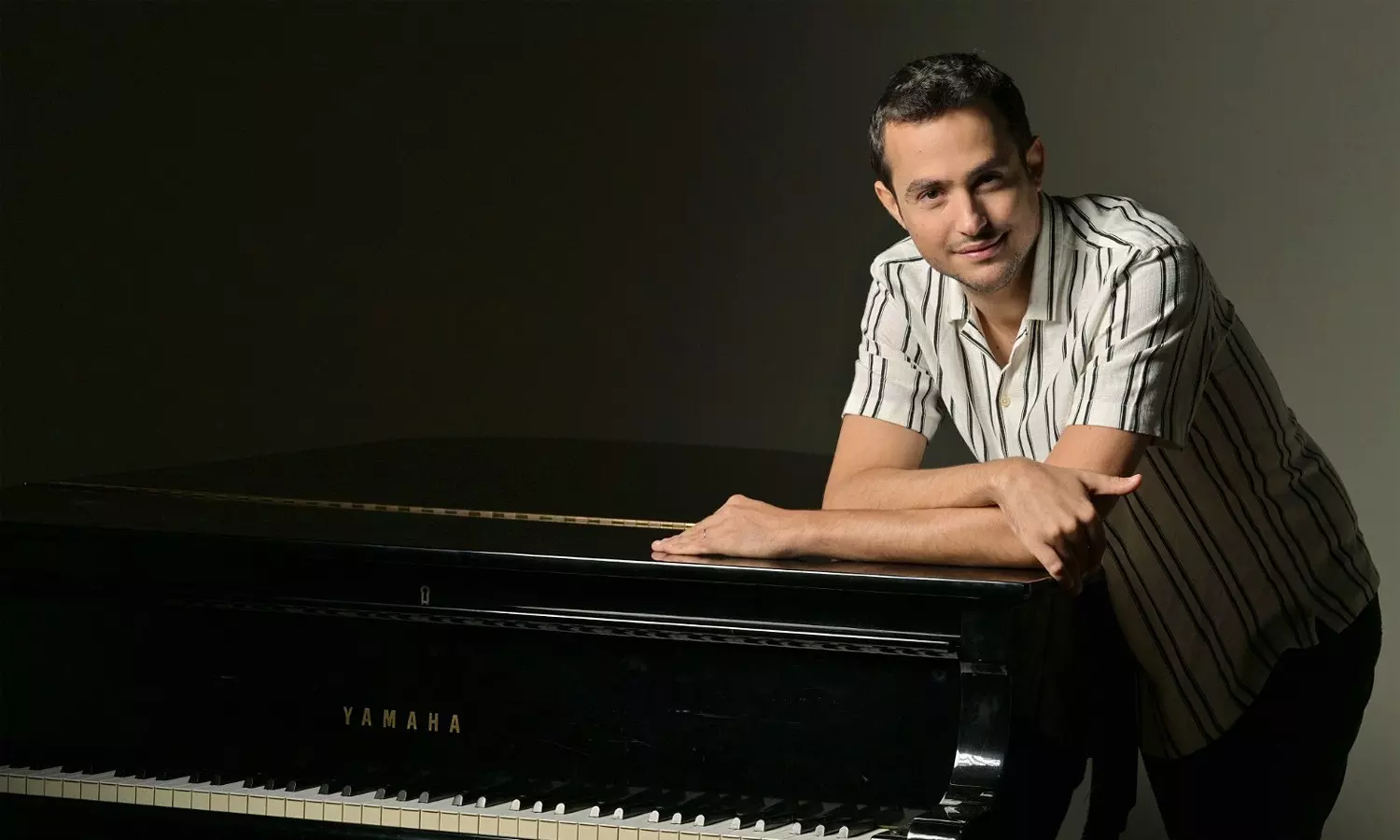
For Guy Mintus, the boundaries between jazz, Western classical music, Middle Eastern traditions and Indian classical music are not as rigid as they may appear on paper.
The Israeli-born piano performer, composer, vocalist and bandleader has spent years moving between musical worlds, allowing influences from different cultures to become part of his own vocabulary. Having lived in New York for seven years, Mintus found himself surrounded by musicians and traditions that expanded his understanding of what music could be.
“What connects them to me is that I am really fascinated and I love them,” he says, speaking about the different musical traditions that have shaped his work. “They have touched me in different points of my life. And they are also, in a way, part of my heritage, especially Middle Eastern music.”
For him, the connections emerge through exploration. “I think music is music,” he says, recalling a line often attributed to American jazz pianist Duke Ellington about there being good music and everything else. “Whatever is good music to you, you should enjoy it and come to it openly as much as you can.”
That openness has also shaped Mintus’ relationship with Indian classical music. During his years in New York, he interacted and performed with musicians from different parts of the world, including artists rooted in Indian classical, flamenco and African musical traditions.
Among those who left a lasting impression was Pt. Samir Chatterjee, the tabla maestro with whom Mintus studied at the Manhattan School of Music. He also worked with musicians, including vocalist Rupa Mahadevan, mridangam player Rohan Krishnamurti and others connected to the Carnatic tradition. The group performed together and even toured India, experiences Mintus says he continues to cherish.
What fascinates him about Indian classical music is its depth, particularly the possibilities that exist between what may appear, to an outsider, as fixed notes.
“Sometimes in Western classical music, we see this note and this is the distance,” he says. “But in Indian classical music, between these notes, it’s like a whole world.”
The rhythmic and melodic richness of the tradition has been a source of inspiration, he says, adding that the encounter with Indian music changed the way he listened to musical spaces he may once have overlooked.
Improvisation is another essential part of Mintus’ approach. How much freedom he has depends on the setting. A solo piano performance offers far greater possibilities than playing with an orchestra, where a musician has to work within a larger structure. Yet, regardless of the format, Mintus believes every performance needs to contain an element that has not been decided in advance.
“To me, it’s important that every performance has this element of surprise, of spontaneity, of improvisation, of the unknown,” he says.
That does not always mean creating an entire piece on the spot. Sometimes, it is about the decisions made while playing a familiar composition. Timing, phrasing and interpretation can change the way a story is told.
“There are infinite ways to tell the same story,” he says. That sense of unpredictability, he believes, keeps a performance alive. It also allows him to remain connected to the audience, the room and the present moment.
His relationship with the piano itself began without any grand plan. As a child, he had access to a keyboard belonging to his grandparents and an old piano at another grandmother’s home. Curiosity led him towards the instrument and, gradually, towards studying music.
Today, he sees both its enormous possibilities and its limitations.
“The piano is like a full orchestra, basically, in one instrument in a way,” he says, referring to its harmonic range. At the same time, its notes are fixed in ways that other instruments are not. Unlike a violin or a sitar, a pianist cannot slide freely between notes, and once a key is struck, the sound begins to fade.
The instrument also presents a challenge that is less obvious.
“To play the piano, you don’t have to breathe,” he says, explaining that unlike singers or players of wind instruments, pianists can physically continue playing without the natural pauses imposed by breath.
That can lead to overplaying, something he says he has had to learn from and is still working on. Connecting music to the body and to the human experience eventually also led him towards singing.
The importance of the human presence in music is something Mintus returns to repeatedly. When different musical traditions meet, he does not necessarily think in terms of one overpowering another. Instead, he sees the process as one of finding balance.
“Even classical Western classical music, two people would play the same piece and it would never sound the same,” he says.
The personality of the musician remains present, regardless of the music being performed or the traditions being brought together.
“I think no matter what you do, your personality is still going to be there,” Mintus says. “The work is really to dig deeper and kind of bring it out more raw, more real, more honest, more human.”
It is a thought that he feels has become even more relevant at a time when technology and artificial intelligence are increasingly capable of imitation. For Mintus, the individuality and realness of an artist, particularly in a live performance, cannot be separated from the music itself.
His upcoming interaction with younger musicians at Pianoforte is another opportunity for exchange. Mintus says he is looking forward to hearing what inspires them and sharing ideas across generations and cultures.
“The love for music, the love for the piano connects us,” he says.
He also sees such exchanges as part of the way music is passed on. India’s guru-disciple tradition, he says, is something he finds deeply inspiring, particularly the idea of learning from an elder and absorbing their knowledge. At the same time, he is beginning to experience the other side of that exchange, meeting younger musicians and discovering what they bring to the art.
Ultimately, his journey across countries and musical traditions has reinforced his belief in music’s ability to create connections that cannot always be explained.
“Music is the messenger. It’s not the message itself,” he says.
The message, he believes, may not always be something that can be translated into words. But when music moves from one person to another, something is communicated.
“You hear music and it touches you, something happens there,” Mintus says. “A message comes across that you can’t really explain in words exactly.”
For him, that is what makes music one of the most powerful forms of human connection.
“It has opened doors and unlocked different adventures and situations that I could have never believed,” he says of travelling and performing around the world. “I was just a vessel for it.”
And perhaps that is also the idea that runs through his music. The traditions may be different. The instruments may change. The cultures may come from different parts of the world.
But somewhere in between, there is always a meeting point.
And for Guy Mintus, it begins with a simple belief: music is music.
The award-winning pianist and composer Guy Mintus will perform at the NCPA, Mumbai, as part of PianoForte, an evening celebrating the piano’s versatility across jazz, classical, soul, funk and contemporary music.
He will share the stage with young musicians Noah Cerejo and Mantra Upadhyay on September 17, 2026, at 7 pm at the NCPA Experimental Theatre.

Comments (0)
No comments yet. Be the first to share your thoughts!
Leave a Comment
Your comment will appear after moderation. Your email will not be published.