
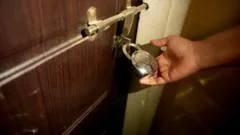
Satyawadi Rakshak Party says it spent millions of dollars during 2024 elections - but its office is now shut
There was little to suggest that the locked flat in Anand, in the western Indian state of Gujarat, was the headquarters of a political party.
There was no signboard, campaign poster or obvious trace of political activity. But on paper, the Satyawadi Rakshak Party had recently received an extraordinary amount of money.
In the financial year ending in March 2024, official records show the Gujarat-based party received more than 3.3bn rupees (approx $35m; £25m) in donations. A few months later, when India held the world's largest general election, it fielded a single candidate, who lost his deposit.
Its accounts say that 84.8m rupees went towards election campaigning, while more than 3.16bn rupees were listed as spending on "public welfare".
"We have spent the money on charity but have not maintained records," said Swati Ben Patel, the party's president, who lives in the same residential complex as its registered office.
The party is one of more than 2,800 Registered Unrecognised Political Parties, or RUPPs - a vast but little-known tier of Indian politics. These parties are legally registered but have not won enough votes or seats to be recognised at the state or national level.
Some contest elections only sporadically or field a handful of candidates. Yet, like larger parties, they can receive donations and claim tax exemptions. Donors can also reduce their taxable income through eligible contributions.
The rules are intended to support political activity, but tax officials say they can be misused.
A months-long BBC investigation examined six RUPPs that reported some of the largest donations in 2023-24. Together, they received about 17bn rupees, despite fielding just 15 candidates in the 2024 election. None came close to winning.
The gap between the money some parties receive and their limited electoral presence has drawn increasing scrutiny from India's tax authorities.
An internal Income Tax department document reviewed by the BBC shows that officials have been investigating suspected misuse of RUPPs since at least 2022.
It identifies 55.91bn rupees in suspected bogus political donations made by taxpayers seeking tax benefits, as well as 6.65bn rupees in foreign transactions. It also notes possible violations of tax, foreign-funding and election laws.
None of the six parties examined by the BBC has been publicly named in these wider inquiries. The BBC has not established that any of them committed financial wrongdoing.
But in several cases, it found a striking gap between the way the organisations were described in their records and what reporters encountered on the ground.
Some registered offices were closed or appeared inactive. Party officials sometimes said they did not control their organisations' finances or could not explain how large sums had been spent.
One of the parties printed election campaign posters - but its candidate says she never visited the constituency
The BBC found signs that the political presence of some of these parties was limited. Although their websites sometimes carried photographs of door-to-door canvassing, one candidate, Indradevi Hiralal of the Garib Kalyan Party, said she had not visited her constituency to campaign in 2024. She showed a single poster printed for the election.
There were also signs of scrutiny from the authorities. Three parties said they or their officials had faced action by the Income Tax department. At a fourth, a relative of a party official said the family home had been searched. The other two denied facing such action.
Tax authorities in Bihar, Gujarat and Delhi, as well as the Central Board of Direct Taxes, did not respond to questions about whether any of the six parties had been investigated or subjected to searches.
Of the six parties, Aam Janmat Party reported receiving the most money.
Founded in Patna in 2020, it reported no individual donations above 20,000 rupees - the threshold at which donors must be identified to the Election Commission - during its first two years.
Aam Janmat Party reported 2.16bn rupees in donations in 2022-23. The following year, the figure nearly tripled to more than 6.2bn rupees - more than twice the roughly 2.8bn rupees received by the Indian National Congress, the country's main opposition party.
Aam Janmat Party officials could not explain the sudden rise.
Aam Janmat Party party fielded just one candidate in the 2024 general election. He received a tiny share of the vote and lost his deposit.
The office of Aam Janmat Party, which reported receiving 2.16bn rupees in donations in 2022-23
The BBC traced its founding president, Anamika Paswan, to Patna city in Bihar state. Paswan, now a vice-president of the governing Bharatiya Janata Party (BJP) in the state, said she had resigned from Aam Janmat in 2022.
When reporters later sought documents relating to her departure, Paswan was not present. Her husband produced what he said was her resignation letter and another document stating that the party had moved hundreds of miles west to Ahmedabad in Gujarat state with Gaurav Mishra as its president.
But the office at its registered address there was shut.
Its treasurer, Dharmendra Vaishnav, said by telephone that Aam Janmat had "shut operations". He said he knew nothing about its finances and directed questions to Mishra, who did not respond to repeated calls and messages.
The party's listed bank account, however, could still receive money. The BBC transferred a small donation and the payment went through.
The registered office of the Garib Kalyan Party was also closed.
It reported receiving 1.38bn rupees in donations in 2023-24, but fielded just three candidates in the general election.
At the home of its president Neeraj Kumar Kshatriya, his mother said she knew little about the party. But she recalled Income Tax department officials searching the family home, although she did not know why.
Researchers who track political finance say the pattern raises questions about what these parties do with the money they receive.
"These parties are not electorally active, yet they are getting such huge funds and they are spending the money as well," said Shelly Mahajan, a researcher at the Association for Democratic Reforms, an election watchdog.
Tax authorities are investigating the massive amounts of money being donated to RUPPs in India
But tracing such transactions can be difficult. Tax officials told the BBC that money can pass through a web of taxpayers, political parties and intermediaries, obscuring where it came from and where it ultimately went.
The BBC could not establish that any donations to the six parties had been returned in this way.
It did, however, trace two people listed as donors to the New India United Party who said they had claimed tax benefits on their contributions.


Comments (0)
No comments yet. Be the first to share your thoughts!
Leave a Comment
Your comment will appear after moderation. Your email will not be published.